
For years my symptoms didn’t quite fit just hemiplegic migraine. Close enough, though, that they kept getting lumped in there, but something was always off. So I started digging. Cause, like, why?
Late last year into this year I went through SO much testing here in Dallas. Tilt table, vascular ultrasounds, genetic swabs, nerve studies. Stuff I’d never even heard of in all my years of being chronically ill, and that’s saying something at this point. Ha!
Here’s what we found.
I have Ehlers-Danlos Syndrome (EDS). Hypermobile type confirmed (hEDS), but we’re still digging into whether there’s more going on, so I’m now seeing a geneticist to dig deeper. I’ve also got psoriatic arthritis and undifferentiated connective tissue disease, so this workup isn’t just chasing EDS, it’s trying to see how all of it ties together. I just sent my DNA off to two different labs. One’s running a big 92-gene panel for EDS and connective tissue stuff, the other is doing a full chromosome microarray through GeneDX. That one’s looking at the bigger picture… my geneticist also diagnosed me with short stature disorder. I’m 4’11”, and while I do have some shorter relatives, most of my immediate family runs average height. When short stature shows up alongside this many overlapping conditions, it’s worth asking whether something chromosomal is connecting the dots. A microarray looks at the whole chromosome picture (missing pieces, duplications, rearrangements) things a targeted gene panel wouldn’t catch. So we’re checking.
Oh, and I’ve had a mild Chiari malformation for years that every doctor has shrugged off as a nonissue. Now I’m side-eyeing it like, are you sure though?
Then there’s the postural symptoms without tachycardia diagnosis. Basically POTS but instead of my heart rate shooting up when I stand, my blood pressure does. Same chaos, different gauge.
And venous insufficiency, because of course. I spent basically all of June getting radiofrequency ablation done on my legs. My veins have officially become a project.
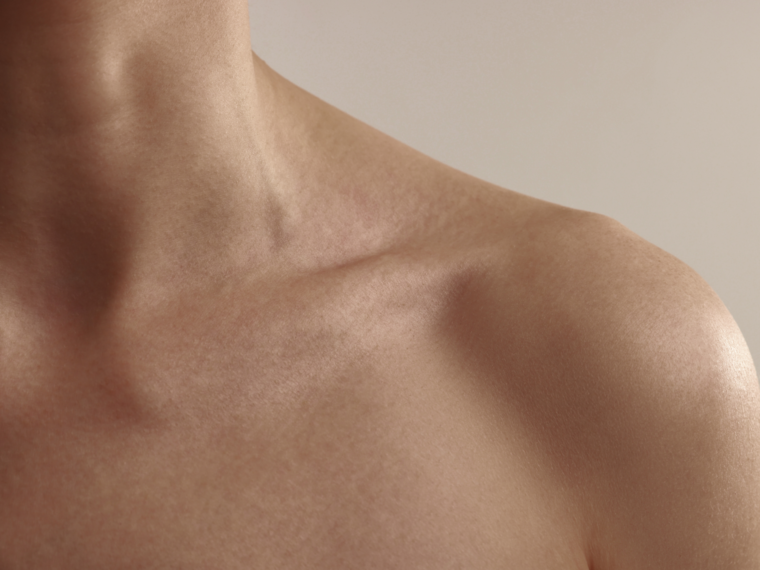
Somewhere in all this imaging, something new showed up. It sent me to a neurovascular surgeon, who diagnosed me with Thoracic Outlet Syndrome (TOS) on BOTH sides. That’s where nerves, arteries, or veins get squeezed in the space between your collarbone and first rib. Turns out it explains a lot migraine never could.
“Turns out it explains a lot migraine never could.”
When I told my headache specialist about it, she actually got excited. Said it might explain a lot of my left-sided symptoms they’ve never been able to pin down.
Here’s why that matters. TOS on the left side can compress the subclavian artery, vein, or the nerves of the brachial plexus. When that compression affects blood flow or nerve signaling, it produces symptoms that look exactly like unilateral migraine: one-sided head and neck pain, left arm numbness or weakness, visual disturbances, even dizziness. Because the overlap is so heavy, it often just gets absorbed into the migraine diagnosis without anyone questioning whether something else is driving it.
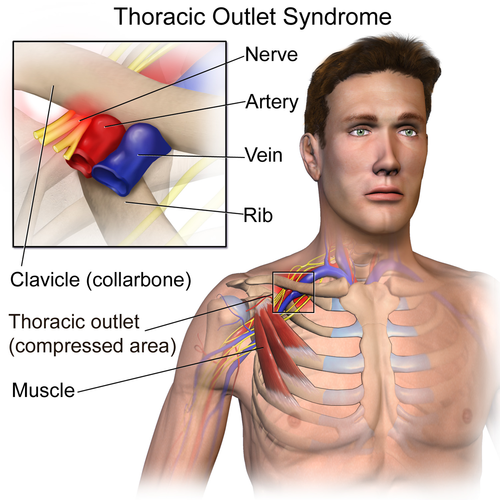
The nerve piece is especially relevant for me. The brachial plexus shares roots with cervical nerves that feed into the trigeminocervical complex, which is basically the nerve hub that migraine activity runs through. Compression there can trigger or amplify migraine attacks… or mimic them entirely.
So some of what we’ve been calling migraine activity on my left side for years may actually be referred symptoms from compression that was never treated, because nobody knew it was there. That’s a big deal. And honestly, kind of a relief.
So on July 7th I’m having a scalenectomy and first rib resection on the left side. Basically giving Adam his rib back at this point 🤣. He’s also doing a pec minor release and a brachial plexus neuroplasty, which means he’s going in to decompress the nerve bundle that’s been compressed alongside everything else. That last one feels significant given everything we just figured out about my left-sided symptoms. I’ll do the right side later this year.
More updates as I recover. Just wanted to get all this written down before I go in.
Quick Education: What These Conditions Actually Are
I throw around a lot of diagnoses in this post, so here’s a quick breakdown for anyone who wants the medical Cliff’s Notes.
Hemiplegic Migraine
A rare subtype of migraine with aura that causes temporary weakness or paralysis on one side of the body, along with the usual migraine symptoms like head pain, visual disturbances, and sensory changes. It can look like a stroke, which is part of why it’s so often misdiagnosed or dismissed early on. It can be genetic (familial) or occur without a known family history (sporadic). Learn more
Ehlers-Danlos Syndrome (EDS)
A group of connective tissue disorders that affect collagen, the protein that gives your skin, joints, blood vessels, and organs their structure and elasticity. The hypermobile type is the most common and the only one without a confirmed genetic marker, which is part of why diagnosis relies so heavily on clinical evaluation rather than just a blood test. Learn more
Chiari Malformation
A structural issue where part of the brain (the cerebellum) extends into the spinal canal. Severity varies a lot, some people are asymptomatic, others have significant neurological symptoms. Mine has been called “mild” for years, but given everything else that’s surfaced, it’s worth a second look. Learn more
Postural Symptoms Without Tachycardia (PSWT)
A newer area of study in the dysautonomia world. Like POTS, it involves the body struggling to regulate itself when you change position, without the heart rate spiking. Less recognized than POTS, but very real.
Venous Insufficiency
This happens when the valves in your leg veins don’t work properly, letting blood pool instead of flowing back up to the heart efficiently. It can cause swelling, pain, and visible vein changes, and is often more common in people with connective tissue disorders due to weaker vein walls. Learn more
Thoracic Outlet Syndrome (TOS)
Compression of the nerves, arteries, or veins in the space between your collarbone and first rib. Depending on what’s being compressed, symptoms range from pain and numbness to circulation issues in the arm and hand. Surgical decompression, like what I’m having on July 7th, is often the path forward when conservative treatment (scalene blocks and/or physical therapy) doesn’t resolve it. Learn more
Why This Matters During Migraine and Headache Awareness Month
June is Migraine and Headache Awareness Month (#MHAM), and this year’s theme is “Migraine itself may be invisible, but the people living with it are not.”
“Migraine isn’t a symptom. It’s a purse full of pens, nickels, lipstick, and a mirror — all symptoms from different systems within the body.”
That one’s sitting with me this year more than usual. Because for most of my life, everything got filed under migraine. Weakness on one side? Migraine. Blood pressure weirdness? Migraine. Joint pain, vein issues, fatigue? Migraine, migraine, migraine. It was the diagnosis that stuck first, so it became the bucket everything else got thrown into.
What I didn’t know was how much was actually hiding underneath it.
Here’s the thing though… migraine isn’t a symptom. It’s a disabling neurological disease with a collection of symptoms that can incapacitate a person for days, like it does me. It’s a purse full of pens, nickels, lipstick, and a mirror, all symptoms from different systems within the body. Over 42 million people in the U.S. live with migraine (Miles for Migraine), and a lot of us are also carrying a stack of other diagnoses that took years to name.
If something keeps feeling off and you keep hearing “it’s probably just your migraine,” it’s okay to keep pushing. That’s not being difficult. That’s knowing your body.
I’ll update after July 7th. Nervous but ready to get this rib out of here.
#MHAM Resources
- Migraine and Headache Awareness – by CHAMP
- Coalition for Headache and Migraine Patients – CHAMP
- American Migraine Foundation – 2026 MHAM page
- Alliance for Headache Disorders Advocacy
- Association of Migraine Disorders – AMD
- Shades for Migraine – June 21st Campaign by AMD
- Chronic Migraine Awareness – MHAM page
- Miles for Migraine




2 Comments
Wow, Erica. That’s hard to read….and good to read at the same time. So, so glad you kept digging and are finding answers. Sending good juju for the surgical team on July 7! You’re understandably nervous….we will all be cheering you on from afar.
Thank you so much Dianne!! That means everything. I am definitely nervous, but I have a great team on my side and my family to hold my hand. Thank you for being my cheerleader!
Comments are closed.